Japanese larch is one of the few conifers that earns its keep in a small wood. It is quick, forgiving about poor ground and honest about the seasons: the needles turn gold in autumn and drop, letting light through to whatever grows beneath. Plant it well and you will have a sturdy, wind-firm tree that gives shelter, firewood and useful timber within a couple of decades. Plant it badly and you will spend years wondering why half of it sulked.
This guide covers the practical decisions that matter most — where to put it, how to prepare the ground, how far apart to plant, and what to do in the first few seasons.
What Japanese larch needs
Japanese larch (Larix kaempferi) comes from the mountains of central Japan and has been grown in Britain for well over a century. Unlike most conifers here, it is deciduous. It also grows fast: on a decent site, expect close to a metre a year in the early years, slowing as the tree matures. It tolerates wind, exposure and poorer acid soils better than many broadleaves, which makes it a sound choice for upland edges and exposed corners.
Two things it will not forgive. It needs light, and it needs drainage. A larch shaded by older trees or planted in a boggy hollow will sit still, go thin and eventually die back. Everything else in this guide follows from those two facts.
Choosing a site
Look for open ground with sun for most of the day and soil that drains freely. Slopes and gentle ridges are ideal; flat, heavy clay and hollows that hold water after rain are not. Larch dislikes chalk and thin soils over solid rock, so if your ground is limy, choose something else. If you are unsure, dig a few spade-deep holes across the intended area and watch what happens after heavy rain. Standing water an hour later tells you plenty.
Exposure is less of a problem. Larch is wind-firm and stands up to upland weather, though it flushes early in spring, so a frost pocket can scorch new growth. Avoid the coldest hollow on the holding if you have a choice. It also dislikes salt-laden coastal gales, so keep it back from an exposed shoreline.
If you are planting a mixed wood, larch works well as a nurse species for oak, beech or Douglas fir, giving shelter and side shade while the slower trees establish.
Preparing the ground
The aim is to give young roots a clear run and remove competition, not to create a manicured bed. On rough grass, bracken or light scrub, a good spade notch is often enough. On improved pasture or heavy ground, you may need to strip a metre-wide patch or use a tined cultivator to loosen the top 30cm or so.
Two extra measures are worth considering on difficult sites:
- Mounding or ridging on wet ground — planting on a raised mound keeps roots above the water table.
- Spot weed control before planting — clearing a patch of grass and bracken reduces competition for the first two seasons, when it matters most.
If drainage is genuinely poor across the whole site, do not plant larch there. Choose alder or willow instead and save yourself the disappointment.
Spacing and layout
Spacing depends on what you want from the trees.
- Timber at 2m x 2m — roughly 2,500 trees per hectare. A sensible default for a small productive wood, with thinning later.
- Amenity or mixed planting at 2.5–3m — fewer trees, more room for other species and easier early maintenance.
- Shelterbelts — two or three rows, staggered rather than squared, with the densest line on the windward side.
- Wide margins — leave a strip of unplanted ground along tracks and boundaries. It makes access, inspection and future felling far simpler.
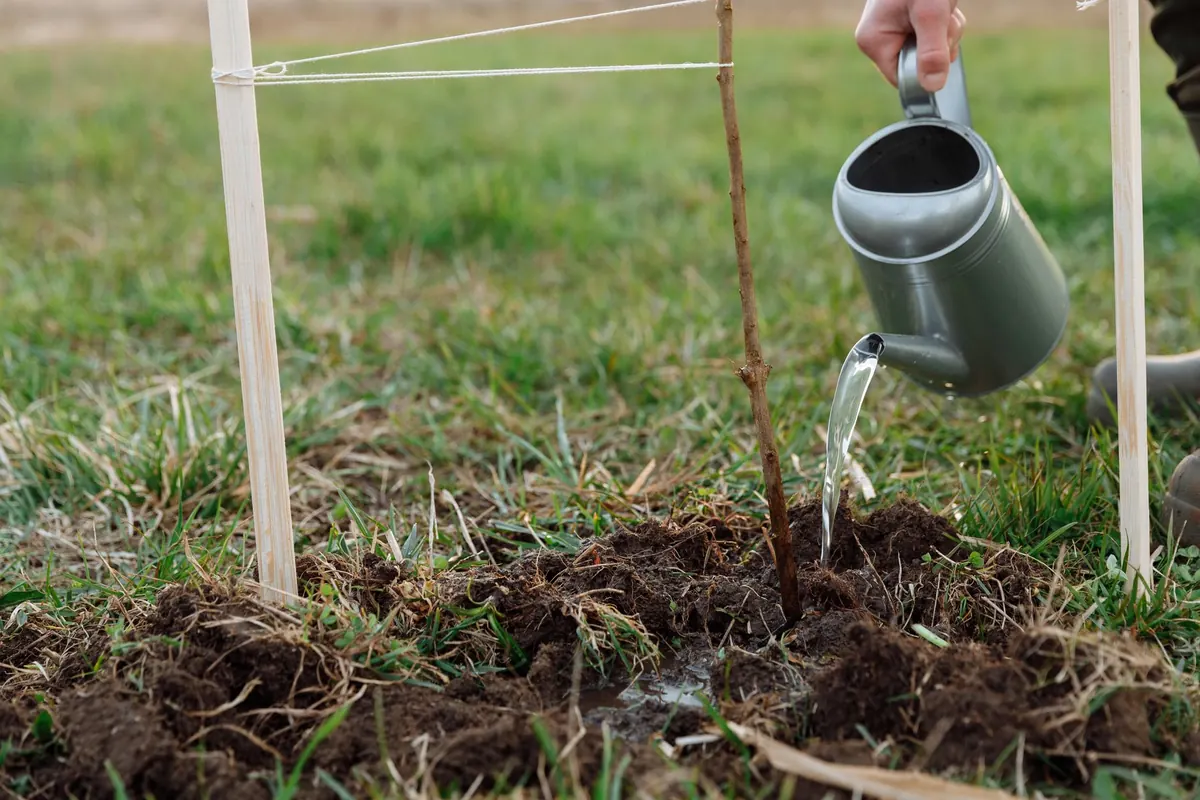
Mark out with canes or a string line rather than pacing it. Wandering rows look untidy for the life of the wood and make thinning awkward.
Planting, step by step
Buy bare-root stock from a British nursery and ask about seed provenance, which affects hardiness and growth habit. Bare-root larch should be lifted and planted while dormant, roughly November to March, and never in frozen or waterlogged ground.
- Collect or accept delivery of your trees when the soil is workable, and keep the roots damp and out of wind at all times.
- If planting is delayed by more than a day or two, heel the bundles into a spare patch of soil.
- Push the spade in vertically, lever a notch open, and drop the seedling in so the root collar sits at ground level — not buried, not perched.
- Firm the soil back around the roots with your heel. Give the tree a gentle tug; if it moves easily, it needs firming again.
- Fit a spiral guard or stake-and-mesh guard where rabbits and deer are active.
Planting on a mild, damp day in early winter gives roots weeks of soil warmth to settle before spring. Trees planted into a dry April will struggle, however good the stock.
Aftercare for the first three years
Weed control is the single most useful thing you can do. Keep a metre around each tree clear for two or three growing seasons, using hand clearing, mulch mats or a suitable approved herbicide. Larch grows away quickly once free of competition, and after that it largely looks after itself.
Walk the planting every spring. Replace failures — usually the ones sitting in wet hollows or smothered by grass — and check that guards are upright and not rubbing. Expect to thin later, once the canopy closes and the trees begin to shade one another; take advice before you start, as a first thinning sets the shape of the wood.
A word on disease and rules
Japanese larch is susceptible to Phytophthora ramorum, which has led to felling in several parts of the country, and planting is restricted in some areas as a result. Check the current position with the relevant forestry authority for your nation — Forestry Commission, Natural Resources Wales, Scottish Forestry or DAERA — before you order trees. Grey squirrels can strip bark, and deer will browse young growth, so plan your protection at the outset rather than reacting later.
Getting started
Start with a small block on your driest, sunniest ground. Order British-grown bare-root stock in autumn, plant by early March, keep the weeds off and the guards up, and give the trees three seasons before you judge them. If the site suits larch, the growth will tell you quickly. If it does not, you will have learned something useful about your ground at the cost of a few dozen trees.
Photo: Thirdman / Pexels